Art Classes online and Face to Face


Basic tools
Gelliplate, paint and rollers
-
When you begin gelli plate printing, my best advice is to choose a trusted brand like Gelliarts or Gellpress. This is important because many lower-quality gell plates may look similar but don't offer the performance. Although making your own gell plate an option, it may not be financially practical considering how often I use one. Buy a smaller plate of these brands rather than a cheap version, you will thank me for this advice.
-
If you're in taking classes with me, I will solely recommend these two brands. While Speedball plates are good, they work best with printing inks, and we will be using Acrylics. Brayer rollers.
-
Brayer Roller - Brayer rollers are an important part of gelliprinting. Again, buy a known brand. I love the gellelf brayer rollers and Speedball. A roller should not be sticky. Cheaper rollers often take the paint off the plate and you will not enjoy using them.
-
Acrylic paint - You can use almost any acrylic paint for most effects. But if you love the look of image transfers, I do suggest Amsterdam acrylics or liquitex basics. American Gelliplate artists use a lot of Golden, but this is not affordable in Australia
Stencils stamps and textures
So you now have a gelliplate
When you get your gelliplate, you will probably want to create some lovely decorative papers - I will have classes showing you the possibilities.
-
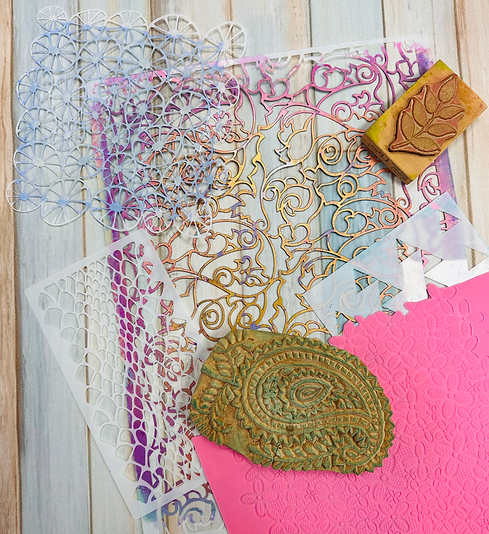
Any stencils will give effects, but I love my stencils to be thin. The mylar stencils are my favourite.
-
You can also make stencils on a cricut cutter using plastic folder sides.
-
You can use a craft knife and make stencils out of thing card, or for better lasting stencils, this plastic sheet.
-
The gelliplate will encourage you to experiment with all textures. Stamps and silicone texture plates that are used for cake decorating are great.
-
Flat shells and jewellery, string, lace doilies, lace of any type.
-
You will start looking for textures, I promise you.


What paper should I use
Horses for courses is what I would say.
-
A lot of people ask me what paper I use. This question is dependant on what you plan to do with your prints. For mono prints ( single pull) prints for card making , you can use photocopy paper.
-
For collage I love rice paper and wet strength tissue paper.
-
For images that are many layers on the plate which I might frame, I use hot pressed watercolour paper.
-
Many papers may not perform well when they are wet and because the gelliplate will resist letting go of the paper, the paper often will fail.
-
In my classes, I will fully explain how this works and how to know what paper to use when and how to trouble shoot your paper issues.
Free things that you can print
Off you go to search
If you are a beginner I do hope you will try to use the free texture things around you.
It is magical to take prints of leaves and botanicals - This will be included in beginners class.
-
around the house you will find bubble wrap, packaging , corrugated cardboard, plastic wrap, aluminium foil, lids from bottles.
-
flat shells, daisies, stones, crocheted doilies, a fork, It is truly endless.
-
IMPORTAND NOTE - do not use things that are sharp and might damage the plate.


